security
CVE-2026-10886: Critical use-after-free in Chrome
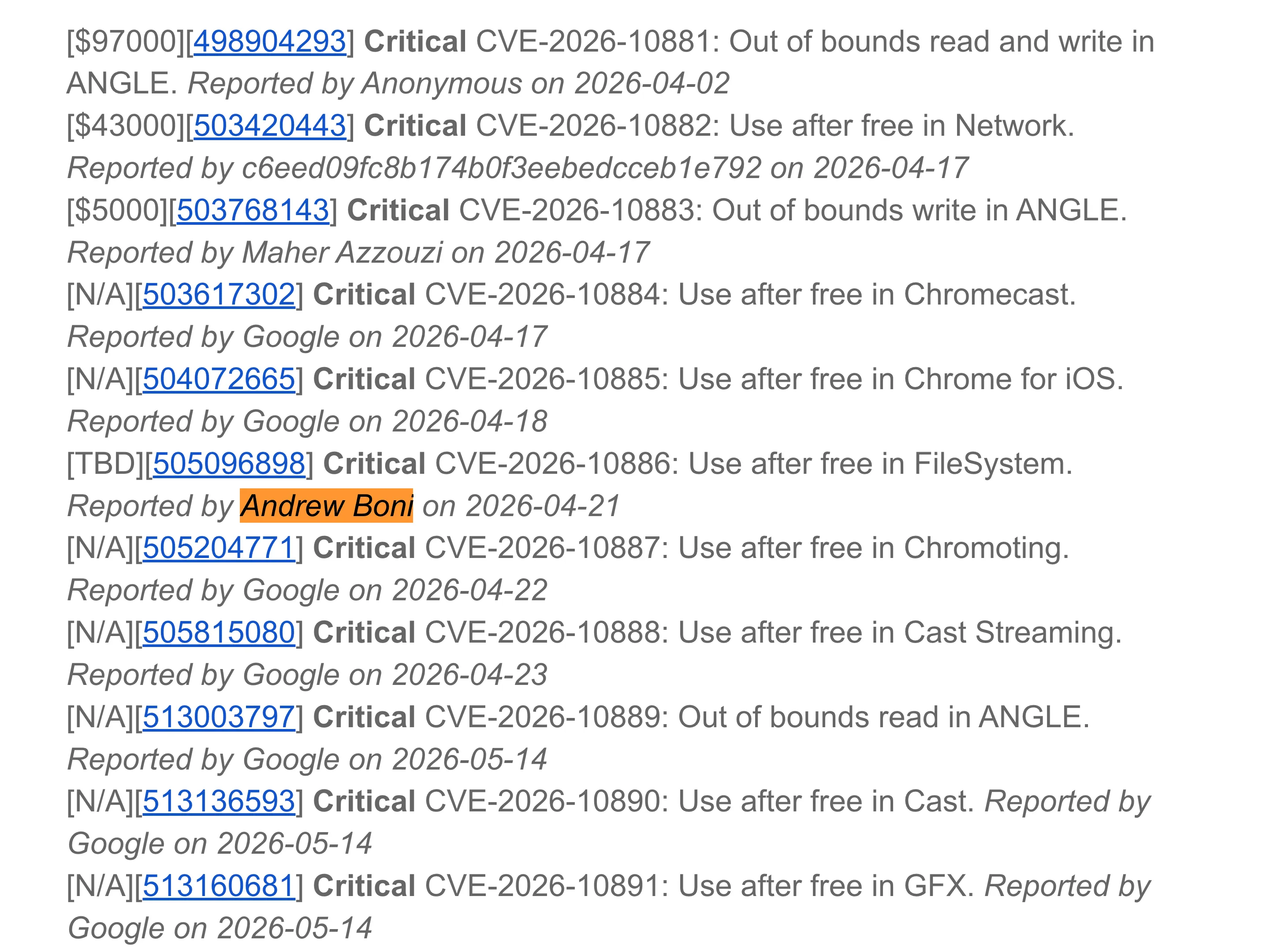
A Critical use-after-free in Chrome's FileSystem, reported to Google's Chrome VRP and fixed in Chrome 149.
- severity
- Critical
- component
- Use-after-free in FileSystem
- reported
- Google Chrome VRP,
- status
- fixed in Chrome 149.0.7827.53 (stable)
Chrome release ↗ NVD record ↗ Chromium bug 505096898 ↗
I discovered a Critical vulnerability in Google Chrome back in April 2026. Google assigned it CVE-2026-10886 and fixed it in Chrome 149 on June 2.
More specifically the bug was this: in Chrome, if you closed the last incognito window, Chrome deleted the private profile, including the browser-process objects holding a page’s Origin Private File System open. But if writes were still in flight, one of those objects was freed while a callback for it sat in a queue. The queue ran and read a function pointer out of memory already given back.
Chrome rates browser-process memory corruption reachable from a page as Critical, the tier for code execution outside the sandbox, even when a check turns this instance into a crash.
I suggested two fixes to the Chrome team: teach the callback that the observer might be gone, or drain in-flight work in the destructor. The fix that landed reference-counts the observers and disables them instead of freeing them, so a late notification does nothing. A follow-up destroys them on the right thread.
Timeline#
- 2026-04-21: reported to the Chrome VRP (Chromium issue 505096898), reproduced on 149.0.7806.0 dev
- 2026-05-22: the primary fix landed on trunk (
crrev.com/c/7805989) - 2026-05-30: the follow-up landed (
crrev.com/c/7884820) - 2026-05 to 06: merged back to the M148 and M149 release branches, and to the M144 long-term-support branch
- 2026-06-02: fixed in Chrome 149.0.7827.53 (stable); the advisory publishes, rated Critical
- 2026-06-04: CVE-2026-10886 and the NVD record published